Home > Blogs > Figurative Language Examples And Types You Must Know
April 8, 2026
Share Article
By
April 8, 2026
Share Article
Recently Updated on April 8, 2026
Figurative Language Examples And Types You Must Know
Home > Blogs > Figurative Language Examples And Types You Must Know
April 8, 2026
Share Article
By
April 8, 2026
Share Article
Recently Updated on April 8, 2026
Figurative Language Examples And Types You Must Know
From poetry to persuasive essays, you encounter figurative language examples everywhere, even if you do not always notice them. When somebody says “Time flies”, they are not talking about the wings. They are using this language creatively to express an idea beyond the literal meaning. Figurative language helps you to communicate thoughts, emotions, and imagination in ways that simple statements cannot.
In this blog, we will explore what figurative language means, why it is significant in academic and creative contexts, and how different forms of figurative language enhance meaning. With these practical examples and strategies, you can effectively use them in your future writing.
What Is Figurative Language
Figurative language refers to the expression that goes beyond literary interpretation. Rather than stating facts directly, you can use comparisons, exaggeration, symbolism, or sound devices to convey a deeper meaning. Understanding clear figurative language definitions allows you to recognize how an author layers emotion and imagination into their work.
For example, if you write “I am buried under homework”, you do not mean that you are physically underground. In the sentence, you are emphasizing stress. These types of figurative language definitions make the abstract emotion tangible and relatable.
In essence, figurative language helps you to:
Paint a vivid mental image.
Trigger emotional responses.
Simplify complicated ideas.
Strengthen persuasive arguments.
When used thoughtfully, it transforms basic writing into compelling communication.
Importance Of Figurative Language In Writing
Literature language forms, however, figurative language engages. This is one of the main reasons it plays such a necessary role across genres. Whether you are drafting a narrative, a speech, or an academic essay, figurative language in writing helps you to connect more deeply with your audience.
For example, imagine the word “stress” scientifically versus describing it as “ A storm brewing inside your mind”. The second version immediately creates imaginary and emotional weight. That is the impact that you can leave on your professors through different forms of figurative language.
You benefit from figurative language because it:
Make writing memorable.
Encourage imagination.
Adds stylist depth.
Clarify abstract concepts.
Rather than overwhelming the professors with an explanation, you guide them through an experience that is real. This is the power behind well-chosen figurative expressions.
Types Of Figurative Language You Should Know
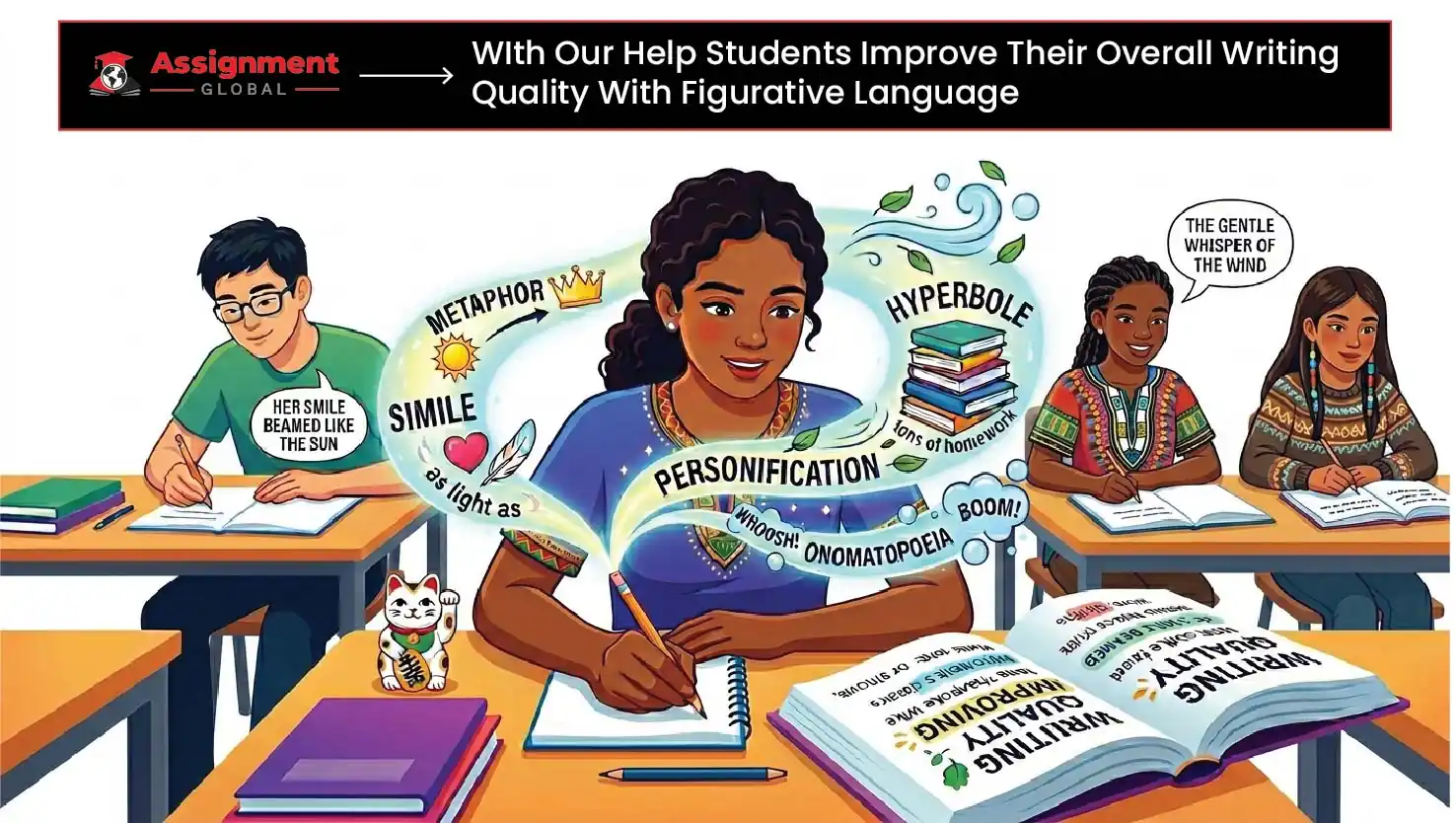
To use figurative language effectively, you need to understand the different types and how they function. Each has a different purpose and tone.
Simile
A simile is used to compare two opposite aspects using “like” or “as”. For example:
She shines like the sun.
He is as stubborn as a mule.
These types of figurative language create a quick and clear image.
Metaphor
A metaphor needs a direct comparison without like or as. For example:
The classroom was a zoo.
Life is a roller coaster.
Metaphors are bold and impactful as they equate to ideas directly.
Personification
Personification allows you to give human characteristics to non-human things. For example:
The wind whispered secrets.
Opportunity knocked on the door.
These are common figures of speech that make the descriptions lively and emotional.
Hyperbole
Hyperbole is deliberate exaggeration. For example:
I have told you a thousand times.
This bag weighs a ton.
It emphasizes the intensity or humour of the sentence.
Alliteration
It repeats initial consonant sounds. For example:
Silver seas shimmer softly.
These types of figurative language add rhythm and musicality to your sentence.
Symbolism
Symbolism uses objects or events to represent a deeper meaning. For example:
A dove symbolizes peace.
Darkness represents fear of uncertainty.
Symbols often appear in literature to convey multiple meanings.
These are among the most common figurative languages that you may encounter in both literature and everyday speech. By getting an overview of it, you can have a roadmap on how to use it in the future.
Forms Of Figurative Language
Beyond basic categories, there are borders that shape, tone, and meaning. These often include:
Irony.
Oxymoron.
Paradox.
Imagery.
Onomatopoeia.
For example:
The silence was definite: paradox.
Bittersweet memory: oxymoron.
Buzz, crash, or whisper: onomatopia
Each of these forms deepens meaning by playing with contrast, sound, or expectation. When you recognize different forms, you gain flexibility in your writing and style.
Powerful Figurative Language Examples Explained
Exploring figurative language through detailed examples is better for understanding how it functions.
The world is a stage: A metaphor suggesting that life is like a performance where everyone plays different roles.
She has a heart of gold: A metaphor symbolizing kindness and generosity.
The stars wink at us: Personification that creates a magical tone.
I am so tired I could sleep for a year: Hyperbole emphasizing exhaustion.
The classroom burst with excitement: Onomatopoeia creating a sound imaginary.
By studying such figurative language examples, you can learn how subtle word choices can create stronger emotional connections.
How To Use Figurative Language Effectively
Understanding theory is only the first step; to apply figurative language successfully, you can follow these strategies:
Be Purposeful: Make sure your comparison is easy to understand. Confusing metaphors weaken your message.
Match Tone And Context: Choose devices that align with your tone. A dramatic metaphor may not suit formal academic writing.
Avoid Overuse: Too many figurative devices in one paragraph can overwhelm readers. Use them strategically.
Make It Original: Avoid clichés like “busy as a bee.” Fresh comparisons make your writing stand out.
When you balance creativity with clarity, figurative language in writing enhances meaning instead of distracting from it.
Figurative Language In Academic And Creative Writing
You might associate figurative techniques mainly with poetry or fiction, but they are equally important in academic contexts as well. For example:
The economy is on life support.
Inflation eats away at savings.
If you look at these figurative language examples closely, then you can notice that the expressions are simplifying complicated ideas and making them easier to grasp. Even in analytical essays, carefully selecting metaphors can clarify any abstract theory.
Many of you may have to use these small details in your assignment, and if you are not able to do that. Then connecting to an assignment expert online is the wisest choice. They know exactly how to play with words and use them to express different ideas.
Mistakes To Avoid
While learning from strong figurative language examples, be mindful of common errors.
Overusing too many elements or crowding the text.
Relying on cliché lines that reduce originality and expression.
Mixing metaphors improperly.
Making comparisons too complicated or abstract.
Using an inappropriate context.
Ignoring cultural barriers.
Creating illogical imagery.
Get 20% OffYour Good Grades Are Just A Click Away!
Mastering figurative language examples empowers you to write with greater depth, creativity, and emotional impact. When you understand how similes, metaphors, symbolism, and other devices function, you move beyond literal expression and communicate ideas more effectively.
If you are in need of a professional to include figurative language, just know that Assignment Global is available for you. Our assignment writing services introduce you to capable professionals who are experienced in using figurative techniques.
DELIVERED ORDERS
EXPERTS
CLIENT RATING
FAQs
What Are Figurative Language Definitions?
The definitions for figurative language explain how expressions go beyond literal meaning to create imagery, emotion, and deeper understanding in writing.
How Can I Identify Figurative Language In A Text?
Look for comparisons, exaggerations, or phrases that do not make literal sense but suggest deeper meaning.
What Are Some Common Figurative Languages Used In Writing?
Common figurative languages include simile, metaphor, personification, hyperbole, symbolism, and irony.
Is Figurative Language Suitable For Academic Essays?
Yes. When used carefully, it can clarify complicated ideas and strengthen your arguments.
How Can I Improve My Use Of Figurative Language?
Read widely, analyze examples, and practice rewriting simple sentences with creative comparison.