Home > Blogs > A Practical Pathway For Code Review And Learn Coding
June 19, 2026
Share Article
By
June 19, 2026
Share Article
Recently Updated on June 19, 2026
A Practical Pathway For Code Review And Learn Coding
Home > Blogs > A Practical Pathway For Code Review And Learn Coding
June 19, 2026
Share Article
By
June 19, 2026
Share Article
Recently Updated on June 19, 2026
A Practical Pathway For Code Review And Learn Coding
Learning to code and program without code review is like writing without ever editing a sentence. Your programming task does not end with error-free coding, but you need to understand, question, and refine it with proper review. To develop a powerful learning loop in programming, it is crucial to engage in Code review and learn coding with best practices.
Here, in this process, every bug becomes a lesson, and each revision becomes a learning experience that hones your programming skills. In fact, what sets a programmer apart from a skilled one is his or her ability to review code. Here, in this blog, you will understand the importance of code review and check the practical steps to conduct one.
Importance Of Code Review In Layman's Terms
Code review is the systematic examination of source code to identify mistakes and improve its quality. At its very core, code review is about reading and analyzing code written by someone else, suggesting corrections, ensuring it follows best practices, and the project guidelines.
For those wanting to know how to become a programmer, code review is an essential skill in this journey. The importance of code review in programming is unmatched, as it catches bugs, improves poor structure, allows collaboration, ensures uniform style across the projects, and provides easier readability. Moreover, this improves teamwork and problem-solving skills, encouraging better coding practices.
The importance of code review is also linked with learning discipline. When students review code regularly, they learn why a solution works, where it fails, and how it can be improved. This makes review one of the most practical methods for improving programming skills.
Practical Code Review Process To Follow: Go Beyond Fixing Errors
One of the practical ways to become a better programmer is to know how to review code. Here, we have elaborated on the effective and practical steps to review code and learn coding, which can be a good programming skills improvement technique too. Check here:
Start With One Language
The smartest way to build a strong foundation and get started with the code review process is to select the right programming language. Choose a language based on your goal, like JavaScript for web development, Python for data and AI, C++ and Java for systems and performance.
It is always advisable not to jump between languages initially, as it slows down the real learning. Also, start with a context like what problem this solves, what the expected output is, etc. Before trying to understand the fancy frameworks, focus on fundamentals like loops, variables, arrays, functions, and basic OOP.
Learn Coding Step By Step
The next important practical approach in code review and learning code is to learn coding step by step. You must read code like a story instead of some technical manual, scanning the entry point, function class, data flow, or the input, processing, and output.
For good code review, focus on one function or module at a time. Practice small coding problems daily, like pattern printing, number problems, or basic logic building. You can also learn to read code by picking a simple beginner project, understanding the structure, and modifying the small parts. You learn to break code intentionally, change the inputs, and fix errors.
If you want to learn coding step by step, keep a review journal. Write what the code does, what error you found, what change you made, and what you learned from it. This habit supports long-term programming skills improvement.
Know The Code Review Basics
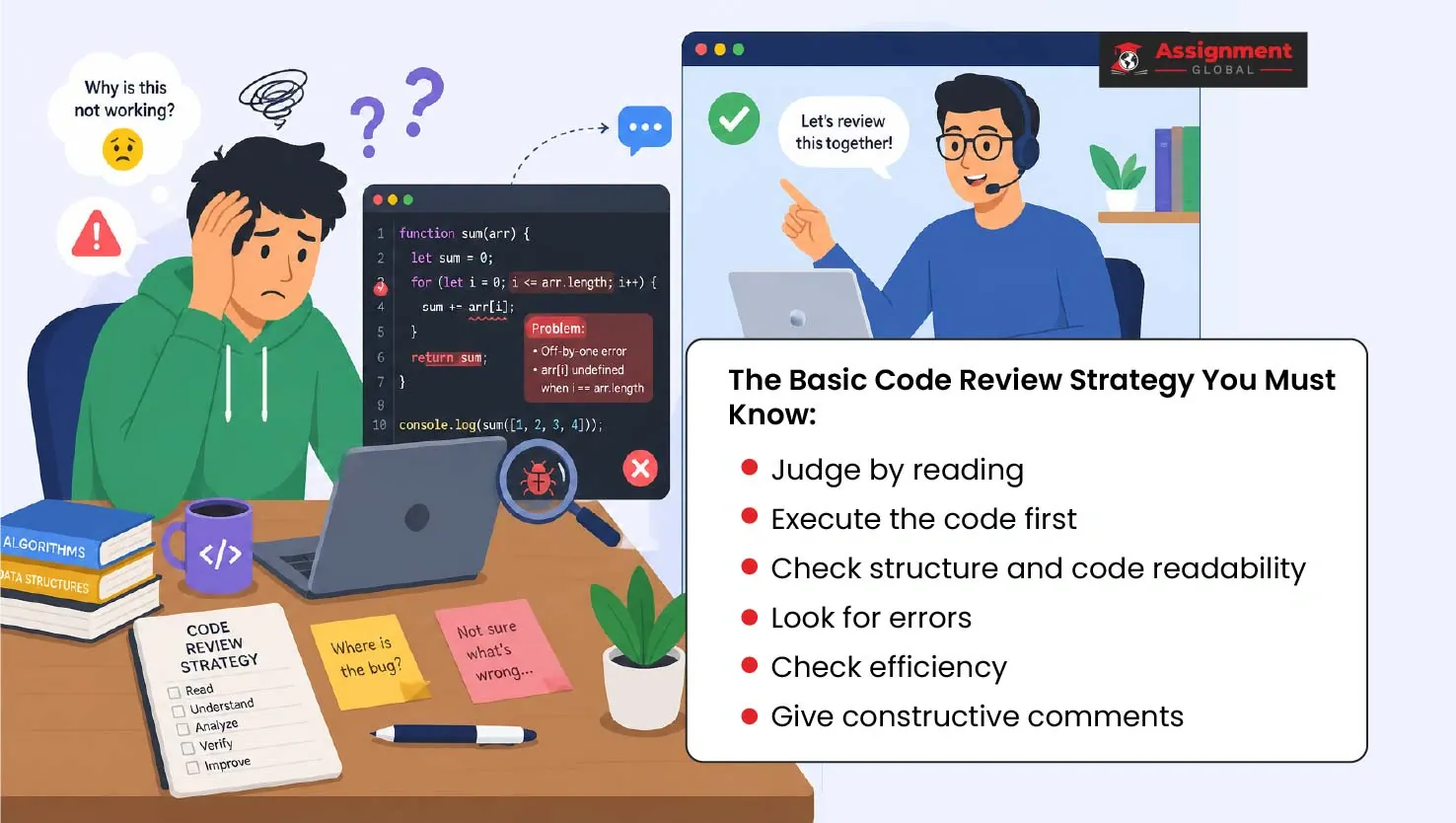
The code review process is not just about finding faults but making code cleaner, safer, and easier to maintain. If you cannot understand the goal, you simply cannot judge the code as well.
The priority is to consider the basics, like whether edge cases are handled properly and whether the code works as expected. By basics, we mean you need to review the variable names, whether they are clear or not, check for small and focused functions, and logical structure. Try to review for logic complexity, unnecessary shortcuts, and one-liners that are hard to understand. Also, you just check for any duplicate logic and repetition.
A practical code review process should include a short checklist: purpose, logic, readability, edge cases, error handling, security basics, comments, test cases and formatting.
Lint Your Code
If your code follows any predetermined code styling guide, then that is called linting. The goal of linting is to make your code highly readable and to be easily understood by professors.
In the process of code review and learning code, linting is useful as it automatically checks your code for bad practices, errors, and style issues. There are tools called linters, depending on the programming language, like ESLint for JavaScript, PyLint for Python, etc. Linting is easy to use and one of the key programming skills improvement techniques for optimised code and its review.
Practice With Real Project
The fastest way to excel in code review and learn coding is to work on real projects. You can pick a small and useful project like the basic blog system, expense tracker, or notes manager.
Work on these small projects while learning the language, by applying functions for adding and removing tasks, lists, and dictionaries for storing tasks, etc. You must also study projects to understand the naming conventions, function design, and folder structure. After you write code, review your own code, checking whether the variable names are clear and whether the logic is repeated.
However, for real Programming project help, you can reach out to us for guidance, debugging support, project structure review and academic explanation.
Learn Version Control
Using version control is how real developers manage code, track changes, and collaborate. It can be the smartest move for programming skills improvement. You can think of it like saving multiple versions of your project, which allows you to collaborate and learn.
You can start with an industry-standard version control system like Git, which runs locally, and GitHub, which stores code online. GitHub can be best learnt through working on projects as you polish your pull request and collaboration basics and learn with real commands.
Version control also makes the code review process more practical because you can compare changes, read comments, request improvements and understand why a solution was accepted or rejected.
Tips On How To Become A Programmer Who Is Wanted For A Project
Want to know how to become a programmer who is in demand? Here are some winning tips that can help you hone your skills:
Build Strong Fundamentals: Your programming knowledge must be deep, instead of wide. Understand the basic data structures and algorithms, learn the memory and time complexity, and read how things work internally.
Stay Consistent With Practice: Consistency is indeed the key in programming. Solve coding problems on LeetCode and build mini projects on CRUD apps. Consider refactoring your own old code and keep improving.
Develop Code Review Skills: Learn code review as a skill. Begin checking for clean naming, simple logic, edge cases, time and space usage, and coding standards. You can explore repositories in GitHub.
Test and Learn From Feedback: Write different unit tests in programming and think like a real developer and reviewer. However, if you need any programming assignment help, reach out to professionals and check sample assignments and their solutions.
Another practical answer to How to become a programmer is to build a feedback loop. Write code, test it, review it, rewrite it, and explain it to someone else. This helps you learn coding step by step instead of jumping randomly from one tutorial to another.
Common Code Review Mistakes Beginners Should Avoid
While the code review process is useful, beginners often treat it only as error-finding. That limits learning. Code review should also check design, readability, naming, reusability, security basics and test coverage. Common mistakes include:
Reviewing too many files at once
Ignoring the purpose of the code
Checking style but missing logic
Giving vague comments like “fix this”
Not testing edge cases
Skipping documentation and comments
Ignoring repeated code
Treating feedback as criticism instead of learning
Avoiding these mistakes makes Code review and learn coding more effective for long-term programming growth.
Get 20% OffYour Good Grades Are Just A Click Away!
If you are willing to become a programmer, relying on shortcuts is not a good approach. You have to learn the best practices, understand how to review code, and learn coding step by step.
In this process, code review is not just a mandatory step but is one of the fastest ways to grow your programming skills. It exposes you to different coding styles, problem-solving approaches, and techniques, where you learn by reviewing others' work. The above practical steps to code review and learn coding can definitely help you.
If not, reach out to our programming experts at Assignment Global, where you just ask to “Make my assignment” and get programming guidance, code explanation, debugging support, and academic project assistance.
DELIVERED ORDERS
EXPERTS
CLIENT RATING
FAQs
What Is The Main Purpose Of Code Review?
The purpose of code review is more than finding bugs. It focuses on maintainability, improving code readability, and design quality. It also helps students understand better coding practices through feedback and correction.
How To Handle Disagreements in Code Review and Learn Coding?
You can give the review based on the coding standards, performance data, and best practices. You can have a one-to-one discussion and understand the logic. The best approach is to discuss the code, not the person, and explain why a change improves readability, performance or maintainability.
How To Measure the Effectiveness of Code Reviews?
Here, you have to check for a reduction in production bugs, code consistency, fewer or no repeated mistakes, and personal knowledge growth. A good review should also lead to clearer code, fewer repeated errors and better team understanding.
What Are The Techniques Of Programming Skills Improvement?
You need a steady mix of practice, feedback, and smarter learning habits like reviewing code. Face real projects as you gain real-life experience and focus on problem-solving. Regular code review, version control, unit testing and refactoring are also useful programming skills improvement techniques.
Do You Offer Assignment Help With All Programming Languages?
Whether it's low-level programming languages, procedural, or OOP like Java, Python, and C++, you get assignment assistance from specialized programming experts.