Home > Blogs > Fundamentals of Database Management: A Student Guide
November 19, 2026
Share Article
By
November 19, 2026
Share Article
Recently Updated on November 19, 2026
Fundamentals of Database Management: A Student Guide
Home > Blogs > Fundamentals of Database Management: A Student Guide
November 19, 2026
Share Article
By
November 19, 2026
Share Article
Recently Updated on November 19, 2026
Fundamentals of Database Management: A Student Guide
Database management is an important topic for students studying computer science, information technology, software engineering, and related subjects. It explains how to collect, organize, store, retrieve, and maintain information effectively. By learning the Fundamentals of Database Management, students build a foundation for working with data and addressing practical information needs.
The Fundamentals of Database Management provide a starting point for connecting classroom theory with hands-on database tasks.
A database is an organized collection of data. A database management system (DBMS), such as PostgreSQL or MySQL, is the software used to create and manage it. Database administration is a related operational role covering tasks such as access management, monitoring, and recovery.
In assignments, students may explain theoretical ideas, design database structures, write SQL queries, and assess applications. Requirements vary, so begin with your current assessment brief.
Key Fundamentals of Database Management
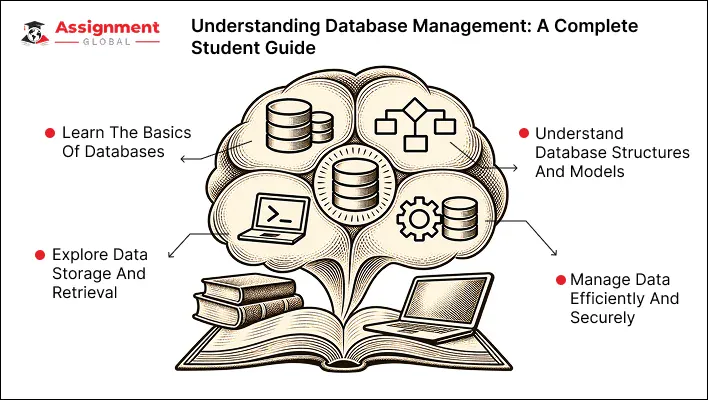
The first step in understanding DBMS fundamentals is studying how databases organize information and control operations. Core database management concepts include:
Database models: Relational, hierarchical, network, and document models organize information differently. Choose a model suited to the requirements.
Database design: Identify entities, attributes, relationships, and constraints before implementing the structure.
SQL and queries: Structured Query Language supports retrieving, inserting, updating, and deleting information in relational databases.
Normalization: Organize relational tables according to dependencies to reduce avoidable duplication and update anomalies.
Data integrity: Keys and constraints help enforce rules, but cannot guarantee that every recorded fact is true.
Database security: Authentication, permissions, and other controls restrict access. Backups and tested recovery procedures support resilience.
For example, a student database with IDs, names, courses, and results helps learners understand tables and relationships. These database management fundamentals are easier to grasp when you build and test a small system.
Why Database Knowledge Matters
Companies need accurate data to understand customers, monitor transactions, manage inventories, and make informed decisions. Understanding the Fundamentals of Database Management gives students a foundation for further study and practical work. The topic offers several learning benefits:
Technical knowledge: Explore database architecture, SQL, and information storage.
Analytical thinking: Identify requirements, analyze relationships, and explain design choices.
Practical problem-solving: Design a database for a library, hospital, or retail store.
Greater consistency: Use constraints and normalization to reduce preventable errors.
Academic skill-building: Practice research, documentation, and explaining technical decisions.
When an assignment involves modeling system requirements, diagrams and database structures may need to work together. Students studying UML can explore Assignment Help for guidance on modeling system components and interactions. Use the diagram notation required by your brief; UML and ER diagrams are not interchangeable in every task.
Important Topics In A Fundamentals of Database Management Assignment
A Fundamentals of Database Management Assignment may ask you to construct a database, analyze an existing system, or explain information handling. Common topics include:
Entity-relationship (ER) diagrams: Represent entities, attributes, relationships, and cardinality before implementation.
Relational systems: Examine tables, primary keys, foreign keys, and relationships.
SQL programming: Practice SELECT statements, filtering, sorting, joins, aggregate functions, and subqueries.
Normalization techniques: Apply first, second, and third normal forms using the relevant keys and dependencies.
Transaction management: Study ACID properties: atomicity, consistency, isolation, and durability.
Security and recovery: Review permissions, backup strategies, and restoration procedures.
NoSQL databases: Explore document, key-value, and graph models where relevant.
Learning these database management concepts helps connect design, implementation, and maintenance. Do not assume all DBMS products use identical SQL syntax or offer the same features.
Database Management Examples: A Student Enrollment System
Start with three tables:
Table
Key fields and purpose
Students
student_id as the primary key; student_name as an attribute.
Courses
course_id as the primary key; course_title as an attribute.
Enrollments
student_id and course_id as foreign keys; the pair as a composite primary key.
A primary key uniquely identifies each row and cannot contain null values. Foreign keys maintain referential integrity by requiring referenced values to exist, subject to the constraint’s null rules.
Separating enrollment records allows one student to take multiple courses and one course to have multiple students. The composite key prevents duplicate student-course pairs in this simplified design.
If a student can retake a course, extend the model to identify separate attempts or terms. Requirements determine the design.
To practice DBMS fundamentals, insert fictional records and join the tables to show student names beside course titles. Then try an invalid course ID and confirm that the foreign-key constraint rejects it.
Other database management examples include library loans and online orders. In both, identify the entities, define relationships, and explain which rules the database must enforce.
Apply the Fundamentals of Database Management by explaining how each table, key, and relationship supports the enrollment requirements.
Turn Database Knowledge Into Practical Skills
A hands-on Fundamentals of Database Management Assignment lets you test design decisions rather than only describe them. Use this workflow:
Read the brief: Identify required outputs, software, and submission files.
Model the data: List entities, attributes, keys, and relationships.
Implement incrementally: Create tables and constraints before adding sample records.
Test operations: Check valid inserts, rejected duplicates, missing references, and query results.
Document decisions: Explain assumptions and record reproducible steps.
These database management fundamentals also apply to transactions. For example, a transfer should not debit one account without crediting the other. A transaction groups related changes so they can commit together or roll back.
When reviewing DBMS fundamentals, distinguish a successful query from a correct solution. Check results against known expected values, including empty results and repeated records where relevant.
Use small database management examples to explain why a design works, not just to produce screenshots. Keep fictional data in student projects unless you have authorization to use real records.
Use database management fundamentals to explain design trade-offs, not simply memorize definitions.
Getting Academic Guidance
If you need Database Management Assignment Help, request explanations, model review, or feedback on your own SQL. Share your brief, schema, error messages, and expected results so support can address a specific difficulty.
Follow your institution’s rules on external assistance and make sure you can explain any revised work.
To review the Fundamentals of Database Management, rebuild the example independently and explain any changes you make.
Get 20% OffYour Good Grades Are Just A Click Away!
The Fundamentals of Database Management connect data organization with reliable retrieval, integrity, and controlled access. Review database management concepts through small projects, test your assumptions, and explain your choices. Consistent practice builds understanding that carries into more advanced study.
DELIVERED ORDERS
EXPERTS
CLIENT RATING
FAQs
What do the Fundamentals of Database Management cover?
They cover data models, database design, SQL, integrity, security, and transactions. Together, these topics explain how systems organize and manage information.
What can a Fundamentals of Database Management Assignment involve?
Tasks may include designing tables, drawing an ER diagram, writing queries, and documenting tests. Follow your assessment brief.
What are some database management examples?
Student enrollment, library loans, and online orders show how related records support everyday activities.
How can students practice DBMS fundamentals?
Create a small database, insert fictional records, and test queries and constraints against expected results.
Which database management concepts should beginners learn first?
Start with tables, keys, relationships, and basic SQL. Then study normalization, transactions, and security.
How do database management fundamentals help with testing?
They help you identify valid data, prohibited operations, and expected query results before running tests.