Home > Blogs > Understanding the 5 V's of Big Data: A Complete Guide
October 27, 2026
Share Article
By
October 27, 2026
Share Article
Recently Updated on October 27, 2026
Understanding the 5 V's of Big Data: A Complete Guide
Home > Blogs > Understanding the 5 V's of Big Data: A Complete Guide
October 27, 2026
Share Article
By
October 27, 2026
Share Article
Recently Updated on October 27, 2026
Understanding the 5 V's of Big Data: A Complete Guide
Big data has changed how businesses acquire, handle, evaluate, and use information. Every day, organizations have to handle huge quantities of data via websites, mobile apps, social media, transactions, connected devices, and digital platforms.
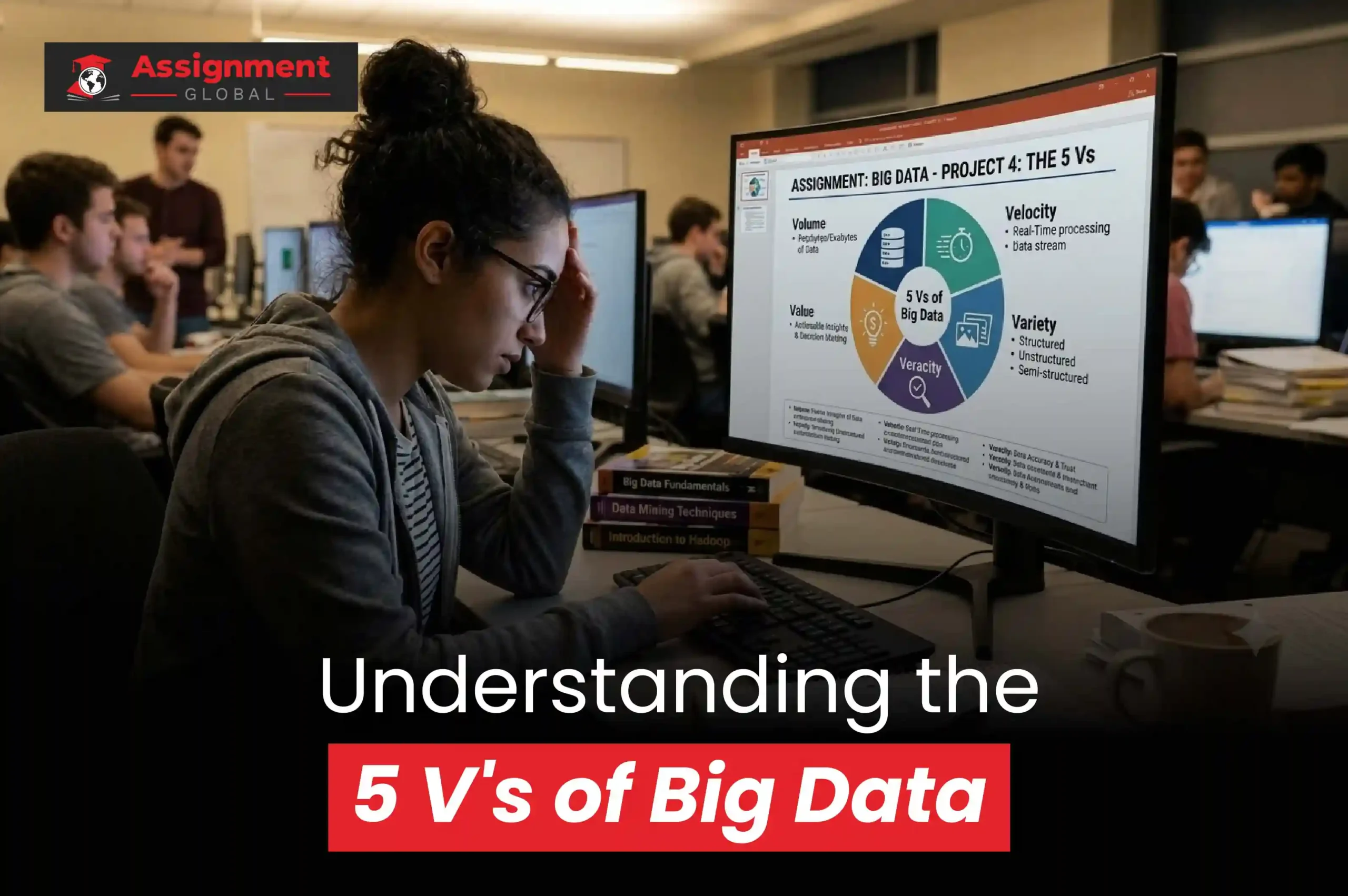
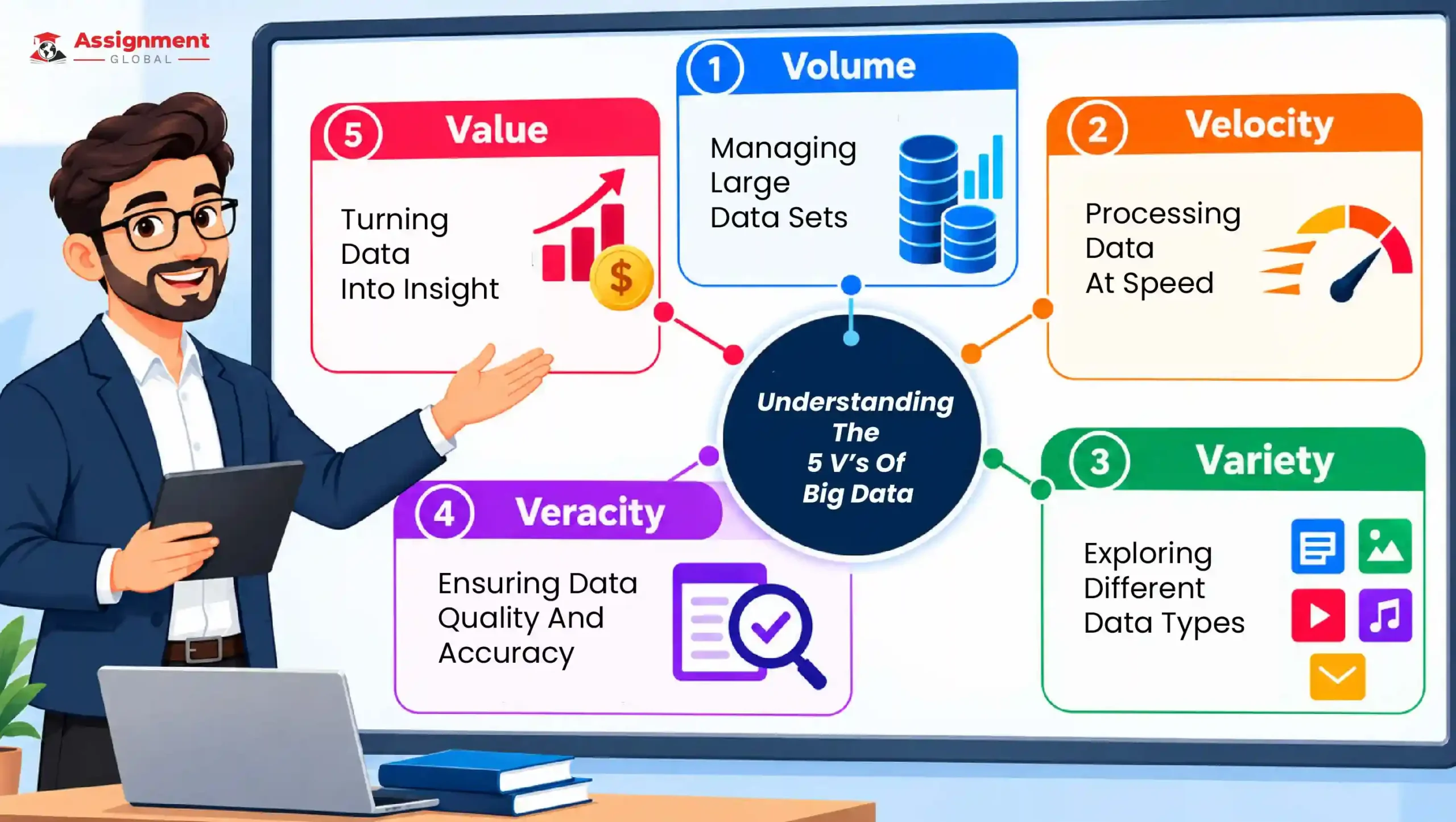
The 5 V's of Big Data help students understand why working with huge datasets can be both difficult and useful. The five Vs of big data are: Volume, Velocity, Variety, Veracity, and Value. Together, these dimensions illustrate the main properties of big data and how businesses can convert complicated information into meaningful insights.
What Are the 5 V's of Big Data?
The framework describes the scale, speed, diversity, reliability, and usefulness of data. The five Vs of big data are five key aspects that affect how data is acquired, stored, processed, and analyzed.
IBM uses this five-part framework in its overview of big data. Other explanations include additional dimensions, such as variability, so the number of Vs can differ between sources.
These ideas also apply to students who work on technology, management, analytics, and research projects. When seeking statistics assignment help, students can ask for guidance on data quality, sampling, and interpreting findings. The five dimensions are:
Volume: the amount of data that is created and stored.
Velocity: the speed at which data is generated, gathered, and processed.
Variety: the range of data types and data sources.
Veracity: the reliability, accuracy, and quality of information.
Value: the practical benefit derived from data.
1. Volume
Volume is the amount of information generated and retained. Organizations may gather customer data, transaction histories, images, videos, emails, sensor readings, and online interactions. One of the most apparent characteristics of big data is the size of these datasets.
The 5 V's of Big Data begin with Volume, as organizations require the right storage and processing technology to handle ever-larger data collections. Cloud platforms, distributed databases, and scalable storage solutions may help organizations manage rising amounts of information.
The five Vs of big data remind us that having plenty of information is not enough for success. Data must be organized and evaluated properly. In an assignment, describe dataset size, expected growth, and why your chosen storage approach fits the task.
2. Velocity
Velocity is the pace at which data is created, received, and processed. Information may be generated constantly through social media updates, online shopping, stock market trading, GPS signals, and Internet of Things (IoT) devices.
Understanding Velocity is key to the big data 5 Vs, since many organizations need to make decisions almost instantly. For example, banking institutions may monitor transactions for suspicious activity, while online shops can react to changing customer behavior.
However, not every task requires real-time analysis. Fraud alerts may need a rapid response, while a monthly sales report can use batch processing. Explain how quickly your example needs an answer.
3. Variety
Variety refers to the different kinds and formats of data companies have. Traditional relational databases mostly hold structured information; however, big data environments also handle unstructured and semi-structured data. Examples include:
Structured: transaction tables with defined columns.
Semi-structured: JSON documents with labeled fields.
Unstructured: the text of papers and emails.
Images, videos, social media posts, and audio recordings.
Among the characteristics of big data, Variety highlights the challenge of combining different formats. The 5 V's of Big Data explain why businesses need adaptable platforms that can integrate information from different sources.
Students seeking IT assignment help can get assistance with schemas, database integration, or matching records across sources.
4. Veracity
Veracity refers to the accuracy, consistency, dependability, and trustworthiness of data. Big data may include duplicate records, missing information, outdated data, inaccuracies, or misleading information.
Within the big data 5 Vs, Veracity matters because unreliable information can produce misleading conclusions. Organizations therefore require methods to clean, validate, and manage datasets.
Data quality is just as important as data quantity. For example, duplicate customer records can inflate customer counts, while missing dates can distort a trend analysis. Check the source, document missing values, and explain any exclusions.
5. Value
Value is the tangible benefit businesses can get from their data. Having millions of records is not enough if they cannot support useful decisions.
Of the 5 V's of Big Data, Value ties data collection to business results. Organizations may evaluate customer behavior, gain insights into operational difficulties, improve products, cut costs, and find new opportunities.
These benefits depend on the quality of the analysis and the action taken. Students seeking business assignment help can ask how to connect an analytical finding to a measurable outcome, such as fewer stockouts or lower processing costs.
Why Are the Five Dimensions Important?
The importance of 5 Vs of big data lies in their capacity to provide a clear framework for understanding a complex information environment.
For example, more Volume may make processing more complex, while more Variety can cause integration problems. High Velocity can increase processing demands. Low Veracity can diminish the Value of analytical findings. Use this checklist to apply the framework in an assignment:
Identify the dataset, its source, and the question being investigated.
Describe its size, arrival rate, and formats.
Check accuracy, completeness, and possible sampling bias.
Explain the decision your analysis could support.
Discuss privacy, access controls, and limitations alongside technical choices.
Applications of the Framework
Many sectors can apply the big data 5 Vs. Healthcare organizations analyze patient information, retailers examine purchase patterns, banking institutions monitor transactions, and manufacturers use sensor data to improve operations.
Understanding the 5 V's of Big Data allows organizations to evaluate whether their data strategies can cope with size, speed, complexity, quality, and value.
Get 20% OffYour Good Grades Are Just A Click Away!
Together, these dimensions describe important characteristics of big data and explain why businesses need effective technology and analytical approaches. Understanding the importance of 5 Vs of big data can help students evaluate data projects rather than simply memorize definitions.
For further academic guidance, ask Assignment Global about big data assignment help focused on concepts, research structure, or reviewing your analysis. Follow your institution's rules for external support.
DELIVERED ORDERS
EXPERTS
CLIENT RATING
FAQs
What are the 5 V's of Big Data?
The 5 V's of Big Data are Volume, Velocity, Variety, Veracity, and Value. They describe data quantity, processing speed, formats, trustworthiness, and usefulness.
Why are the five Vs of big data significant?
The importance of 5 Vs of big data lies in explaining connected data-management challenges. The framework helps students and businesses assess what data they have, how to manage it, and what decisions it can support.
How do the big data 5 Vs apply to an online store?
Orders represent Volume; incoming clicks illustrate Velocity; reviews and transaction tables demonstrate Variety. Checking duplicate orders addresses Veracity, while using findings to improve stock planning creates Value.
Are these the only characteristics of big data?
No. Some frameworks add dimensions such as variability. The five-part model remains a useful introduction; use the framework specified by your course and explain your source.
How can students use the framework in assignments?
Choose a dataset, apply each dimension, and explain the implications for storage, analysis, and decision-making. Cite sources and discuss limitations instead of assuming that more data always produces better findings.