Home > Blogs > A Wholesome Guide To Writing A TFG In English
June 4, 2026
Share Article
By
June 4, 2026
Share Article
Recently Updated on June 4, 2026
A Wholesome Guide To Writing A TFG In English
Home > Blogs > A Wholesome Guide To Writing A TFG In English
June 4, 2026
Share Article
By
June 4, 2026
Share Article
Recently Updated on June 4, 2026
A Wholesome Guide To Writing A TFG In English
Most curricula, whether in American or European universities, prioritize in-depth learning and critical thinking, and Trabajo Fin de Grado, commonly known as TFG, aims to explore such possibilities. It is one of the important assessment types that helps students examine academic topics by studying their underlying principles, research value, and real-world implications.
However, most students who are new to this academic setup struggle to understand what a TFG is and how to approach it. Here, in this blog, we present a practical guide on Writing a TFG in English with steps, format tips, and examples. Keep reading this TFG writing complete guide to understand the process better.
New To TFG Writing Format? First, Know What It Is
TFG, or Trabajo Fin de Grado, is a final year project or undergraduate thesis that is required to complete a bachelor's degree, most popular in European universities, particularly in Spain. It is quite similar to any thesis, final capstone project, or dissertation in any English-speaking academic institution.
The main purpose of TFG writing is to demonstrate your subject knowledge, research skills, and, most importantly, to prepare you for professional roles. TFG writing can be research-based, theoretical, or literature-based, and a practical project like business plan development. It directly helps students with real-life roles by:
Building problem-solving skills.
Strengthening critical thinking and analytical abilities.
Proficiency with data analysis tools and industry frameworks.
Improves presentation and communication skills.
This TFG writing complete guide gives students a clear starting point for planning, structuring, and presenting their work.
A Quick TFG Guide For University Students – Check Steps
Looking for a comprehensive TFG guide for university students? The process becomes easier when you divide the task into stages and follow university instructions carefully.
Select A Focused Topic: If you are allowed to choose your final TFG project topic, then pick a topic that is closest to your personal interest and the degree curriculum. Brainstorm multiple ideas and search topics in similar areas, and get them approved by your professor.
While writing a TFG in English, make sure the topic is specific, relevant, and researchable. For example, instead of choosing “leadership,” you can choose “the role of transformational leadership in employee engagement.” This makes the topic more focused and suitable for academic analysis.
Define The Objective: In TFG writing, the objective works as a guide for the entire project. It helps you define the purpose of the study, decide what you want to analyze, and stay focused while writing.
A strong objective also supports the structure of a TFG writing because it connects your introduction, literature review, methodology, analysis, and conclusion.
No matter what, a strong objective becomes a TFG guide for university students, enabling them to stay focused while writing.
Do Proper Topic Research: Once you know the objective of the TFG writing, define exactly what you want to answer in this assignment. Narrow down the key ideas and concepts and focus on credible and scholarly materials for analysis.
Such sources can be Google Scholar, academic journals, databases, university library books, and published theses. It is important that you do not just collect information but evaluate it, answering questions like what are the main arguments? Are there any contradictions? You can also consider grouping findings into themes.
Maintain Formal Language: One of the important parts of the structure of a TFG writing is maintaining proper language and writing flow. As a student, you must adapt to the writing style not just to your individual preferences but also to the external requirements as dictated by your professors.
It is best to write in a professional and objective tone, avoiding casual expressions. Also, prioritize using the verb form to organize the sentence structure. Professors find it easier to understand if the subjects are shorter. You must favour the passive voice in results sections.
Prepare For Viva: Preparing for a TFG means you need to be ready to present and defend your research. After completing writing a TFG in English, go through the sections to know the topic and background, research objectives, methodologies, and key findings.
This is key to answering viva questions as to why you chose this topic. Prepare a clear and short presentation as per your university guidelines that must follow a TFG writing format. If you are not able to do so, get assignment services help from our experts who can prepare it for you.
Structure Of A TFG Writing
Knowing how to write a perfect TFG assignment is to first understand and implement the TFG writing format. Just like any other form of academic writing, TFG also has a clear academic format. A standard structure of a TFG writing:
Cover Page or Portada: This includes the project title, student name, degree name, supervisor name, university name, and submission date.
Abstract or Resumen: 150 to 300 words summary that includes objective, methodology, key results, and conclusion.
Table of Contents or Indice: List of all the chapters and sections with page numbers.
Introduction: Background information, research problems, and importance of the particular study.
Literature Review or Marco Teorico: Defines the key concepts and reviews the existing studies on the topic.
Methodology or Metodologia: You describe the research types, the different data collection methods, and the samples used.
Results or Resultados: You present the important findings and represent them in tables, charts, and graphs.
Discussion: Here, you interpret the findings, compare the previous studies, and explain the implications and meanings.
Conclusion or Conclusiones: You summarise the key findings and suggest the future research scope in the particular topic.
References: List all the sources used and cite them in the standard referencing styles like Chicago, MLA, and others.
This standard TFG writing format helps students organize their work clearly and meet academic expectations.
TFG Writing Format And Language Tips
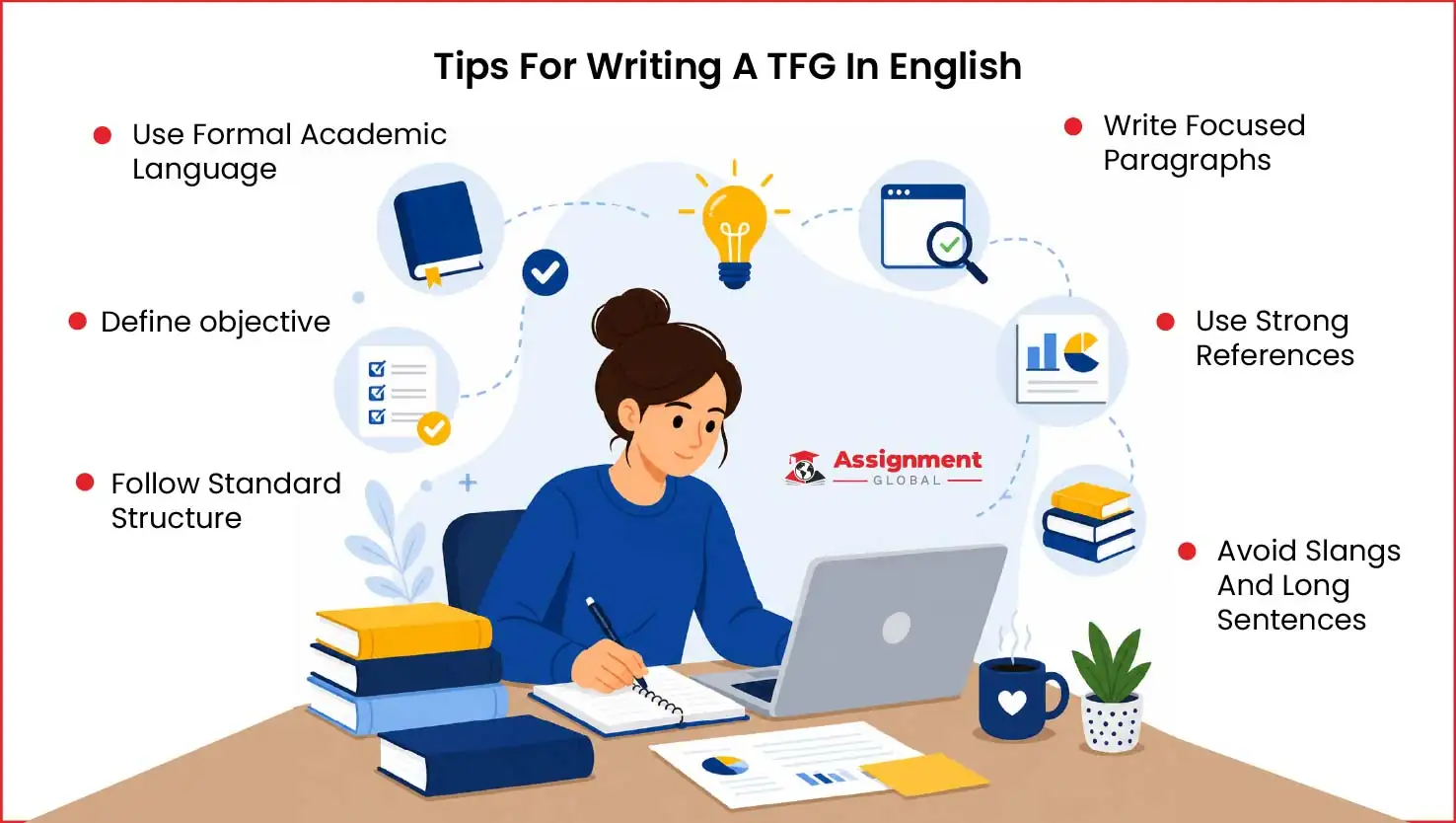
A good TFG writing format is not only about sections. It also includes formal language, logical flow, and correct academic tone. While Writing a TFG in English, follow these tips:
Use a professional and objective tone
Avoid slang, contractions, and casual expressions
Keep sentences clear and direct
Use transition words carefully
Define key concepts before discussing them
Use discipline-specific vocabulary
Avoid personal opinions unless required
Use passive voice only when the focus is on action or results
Check grammar, spelling, and punctuation carefully
Students should also maintain the subject-verb-object connection in sentences. Clear sentence structure makes the work easier for professors to read and assess.
A TFG Writing Example For Beginner
A simple TFG writing example can help you understand and organize your writing better. Check here:
Title: The Active role of leadership in Employee Engagement
Introduction: Leadership is the backbone of any organization and directly impacts the business growth and success. Different leaders have different approaches that impact employee satisfaction and their engagement in organizational performance.
Methodology: A survey of 90 employees and a case study of two top companies and their comparative analysis.
Results: It has been observed that the transformational leadership attitude has helped increase employees' motivation and engagement by around 60 percent. Whereas autocratic leadership has lowered employee interest and led to resignations.
Easy Language Tips For Writing A TFG In English
A quick TFG writing complete guide, especially for the English language, looks like:
Maintaining the subject-verb-object connection in every sentence. Try to maintain proper end focus.
Use transition words carefully. Avoid using slang and contractions like don't, can’t, etc., and remove all superfluous words and phrases.
Avoid personal opinions unless it is really required. Be careful not to use the action of a sentence in the form of a noun, which is also known as nominalization.
Always use discipline-specific vocabulary and introduce the key concepts properly. Use passive voice only to focus on the action.
Get 20% OffYour Good Grades Are Just A Click Away!
By now, you should have a clearer idea of Writing a TFG in English and why it matters in your academic journey. TFG writing is a complete academic process that involves topic selection, research, structure, writing, formatting, and presentation.
Through this TFG writing complete guide, the steps above, and the TFG writing example, students can understand how to plan and write more confidently. If you are still unsure about structure, language, proofreading, or academic presentation, you can explore professional thesis writing services or Assignment services help for guided academic support.
DELIVERED ORDERS
EXPERTS
CLIENT RATING
FAQs
Is Original Research Important in TFG writing?
Mostly it is. However, some TFGs focus on literature reviews and completely theoretical analysis, while others may require empirical research.
What Common Mistakes Do Students Make In TFG Writing?
Choosing overly broad topics, not listening to professors, weak research questions, ignoring formatting and referencing rules, and using too much passive voice.
I am writing a TFG In English. How Long Must It Be?
The length of TFG varies with university guidelines. However, most TFGs have a word count of around 6000 to even 10000 and more.
How Is A TFG Evaluated?
A TFG is evaluated on the TFG writing format, research and data quality, problem statement effectiveness, structure and clarity, presentation, and defense.
How Do Your Experts Make TFG unique?
We choose a focused and relevant topic, use updated information, develop a problem statement that has not been addressed before, and maintain unique arguments.