Home > Blogs > Why Is Plagiarism Illegal Under International Laws?
April 14, 2026
Share Article
By
April 14, 2026
Share Article
Recently Updated on April 14, 2026
Why Is Plagiarism Illegal Under International Laws?
Home > Blogs > Why Is Plagiarism Illegal Under International Laws?
April 14, 2026
Share Article
By
April 14, 2026
Share Article
Recently Updated on April 14, 2026
Why Is Plagiarism Illegal Under International Laws?
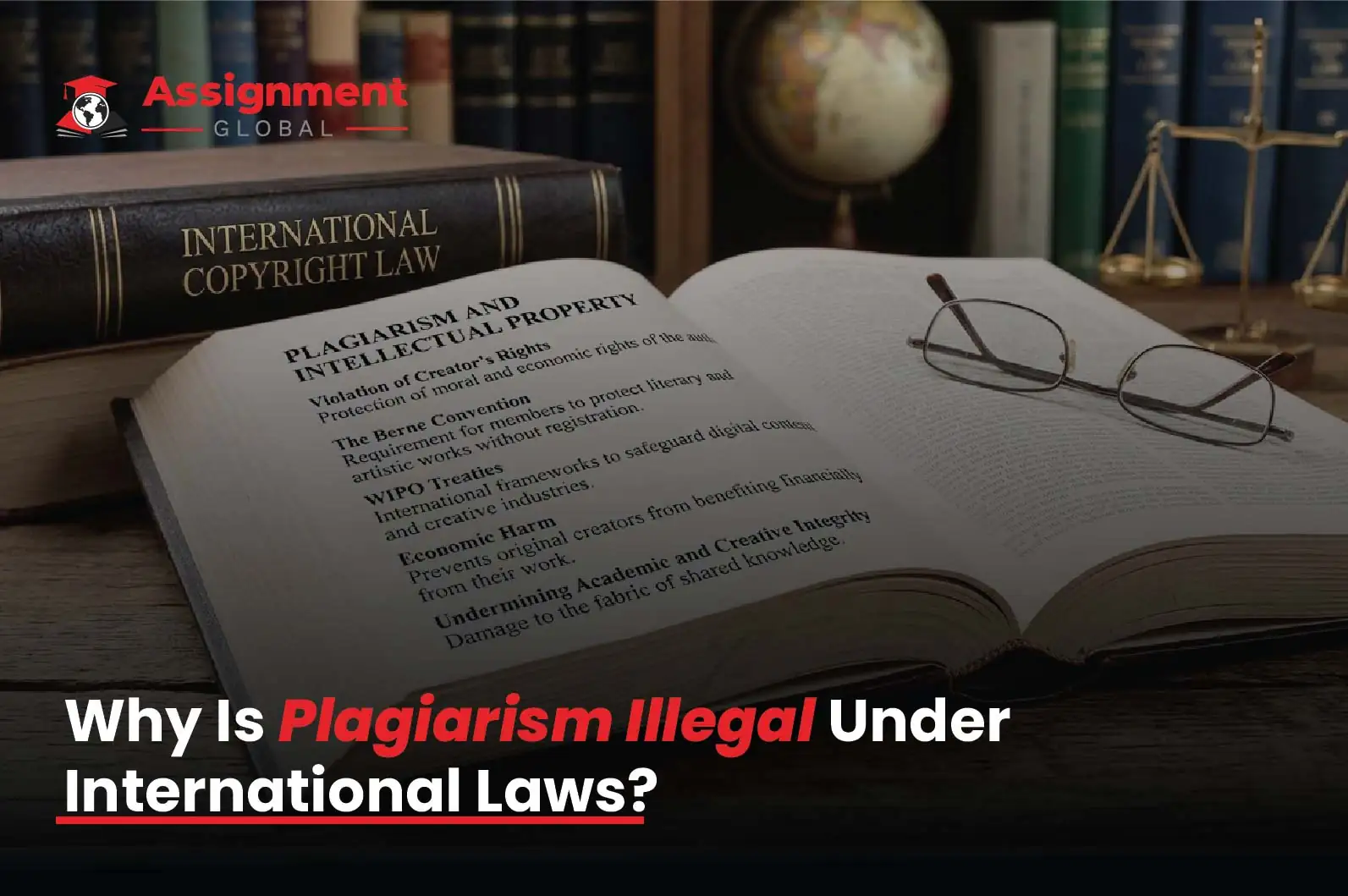
In the current modern world, copying and pasting content has become much easier than ever. Anyone can present someone else's work as their own, which is why plagiarism is illegal under international law and results in serious legal consequences across borders. What may seem like a minor academy shortcut for you is, in reality, a breach of global copyright frameworks and intellectual property protections.
With this blog, we are going to explore why plagiarism is illegal and treated as a legal offense globally. Moreover, we are also going to look at how it connects to copyright infringement and fraud, along with what penalties you may face if you commit it. Understanding these aspects is going to help you to protect your creator rights and your academic world.
Why Plagiarism Is Illegal
Before diving into global frameworks, you need to understand what plagiarism actually means in the legal context. Academically, plagiarism refers to copying ideas, words, or creative work without any proper acknowledgment. Legally, it often overlaps with copyright infringement and intellectual property violations.
When you reproduce someone's original work without any permission, you are not just breaching academic integrity policies. You might also be violating statutory laws that protect intellectual property rights.
This is why plagiarism is illegal, not simply as an ethical concern but as a matter tied directly to ownership rights and economic protection of creative works as well.
Global Legal Frameworks Governing Plagiarism
There is no single global plagiarism law. Rather than that, some international treaties and conventions create a unified structure that many countries adopt into their domestic laws. These are agreements that ensure that creative works are protected across borders.
The Berne Convention: The Berne Convention for the Protection of Literary and Artistic Works (1886) is the foundation and international copyright treaty, governing copyright across over 180 member countries. According to this, if you copy content from a writer in another country, the rights are still protected under this international standard.
TRIPS Agreement: The Agreement on Trade-Related Aspects of Intellectual Property Rights (TRIPS), established in 1995, is directly under the World Trade Organization (WTO). It sets minimum standards for intellectual property protection globally and strengthens the enforcement mechanisms, making copyright violations legally actionable.
WIPO Copyright Treaty: The World Intellectual Property Organization (WIPO) Copyright Treaty (1996) was specially designed to update copyright protection for the digital age. This is particularly relevant for you, as most plagiarism today occurs online.
These frameworks collectively make plagiarism illegal under international laws by ensuring that intellectual property rights are recognized and enforced globally. Violating any of these frameworks can result in serious consequences in your academic and professional life.
Intellectual Property Theft Plagiarism
Plagiarism becomes an illegal issue when it is processed into copyright infringement. Copyright law protects original literary, artistic, and academic works. When you copy substantial parts of someone's protected material without permission, it qualifies as intellectual property theft or plagiarism. This is more than just failing to cite a source. It involves unlawfully exploiting another person's intellectual labor.
Courts often treat such cases as civil offenses, but in some jurisdictions, serious or commercial-scale infringement can result in criminal liability. Because international agreements harmonize these protections, you cannot avoid responsibilities simply because the original creator lives in another country.
The Role Of Copyright In Making Plagiarism Illegal
Copyright gives creators exclusive rights to reproduce, distribute, and adapt their work. These rights are automatic upon creation in most countries. You do not need to register a book or article for it to be protected.
As per plagiarism illegal under international laws, unauthorised copying interfaces with these exclusive rights.
When you submit copied material or academic credit publication online or use it commercially, you potentially violate the copyright law.
International treaties ensure that copyright protection lasts for decades.
Often, the lifetime of the author plus 50 or 70 years. That means copying old material does not automatically make it safe unless it is in the public domain.
Plagiarism, Academic Law And Legal Enforcement
Universities and educational institutions operate under strict academic integrity policies. Yet these are not isolated from border legal principles. In many countries, academic misconduct policies reflect the existence of copyright legislation.
According to academic plagiarism laws, educational institutions may impose penalties such as severe suspension or expulsion. However, if your plagiarism involves commercial publication or financial gain, it may escalate into a legal dispute.
For example, if you public plagiarized research in a journal, the original author may file a civil lawsuit or seek damages. This showcases how academic wrongdoing can evolve into legal liability under the plagiarism penalties of international laws.
Fraud And Misrepresentation
Plagiarism is also closely linked to fraud. When you present someone else's work as your own, you are misrepresenting in authorship. In professional settings, this can amount to deceptive conduct.
Imagine submitting plagiarized work to secure employment funding or a publication. If it is discovered, then it could lead to contract termination or even legal consequences for misrepresentation.
Fraud laws change across jurisdictions, but many countries treat deliberate deception seriously. This is one of the key reasons behind the plagiarism consequences internationally faced by many.
Plagiarism is not only about copying content, but it is also about dishonesty that can cause financial or reputation harm.
Plagiarism Consequences Internationally Faced
While laws can change slightly from country to country, the consequences of plagiarism share common things globally. Under international standards for plagiarism, you may face:
Academic expulsion.
Civil lawsuit for damages.
Financial compensation claims.
Revocation of degrees.
Criminal penalties in severe cases.
The plagiarism penalties international standards are slightly different in all countries.
For example, in the United States, copyright infringement can result in statutory damages and significant fines.
In Australia, the Copyright Act 1968 provides remedies, including injunctions and damages.
The plagiarism penalties in international standards for European Union member states are harmonized by a directive that imposes similar enforcement measures.
Because of international agreements, these penalties are enforceable even when infringement occurs across borders.
Digital Technology And Cross-Border Enforcement
The rise of digital publication has intensified the global enforcement. Plagiarized content can spread globally within just minutes. As a result, international cooperation between countries has strengthened.
Platforms such as academic journals, publishing houses, and online repositories actively use plagiarism detection tools to avoid plagiarism consequences internationally. If you copy content from another country and upload it online, it can be traced and challenged quickly.
This digital environment has reinforced the concept of plagiarism, making it increasingly difficult to escape detection or accountability.
Why You Should Consider Plagiarism Illegal Under International Laws Seriously
Plagiarism is not just an academic issue. Once you understand its connection to copyright, intellectual property, and fraud, it becomes clear why global laws consider plagiarism illegal under international laws seriously.
International frameworks exist to protect creativity, innovation, and fairness. When you plagiarize, you undermine those principles. Beyond legal risks, you also damage your creativity, credibility, and professional reputation.
Understanding it helps you to realize that proper citation, paraphrasing, and original writing are not just academic formalities; they are your legal safeguards, which is why, instead of copying, you should opt for assignment help online. Experts are professionals in original content crafting and avoiding plagiarism risks.
Get 20% OffYour Good Grades Are Just A Click Away!
Plagiarism is not merely an ethical lapse; what makes plagiarism illegal under international laws is copyright infringement, international property theft, and fraud. Through international treaties, original content and its creation rights are protected. If you ignore these rules, you may face academic and civil or even criminal consequences.
If you want professional assistance in creating original content, than Assingnment Global is the one-stop destination for you. Our professional writers craft 100% original content with a free plagiarism report to make sure you avoid any plagiarism claims. Whether you need law exam help or any report writing assistance, we give you our best.
DELIVERED ORDERS
EXPERTS
CLIENT RATING
FAQs
What Is Intellectual Property Theft Plagiarism?
It is the unauthorized use of anyone’s original work without any permission, acknowledgment, or credit that potentially breaches copyright laws.
How Can Plagiarism Academic Law Affect Me?
It links University misconduct rules with National copyright laws, meaning serious cases can lead to academic and legal consequences.
Are Penalties Different In Academic And Professional Settings?
Yes, universities impose disciplinary actions, while professional cases may involve lawsuits and fines.
Can I Be Sued For Copying Foreign Content?
Yes, international copyright treaties allow creators to take legal action across borders.
Does Paraphrasing Prevent Plagiarism Claims?
Not always without proper citation, even paraphrasing ideas can be considered plagiarism.